

Maximizing the Value of PTO: How It Can Drive ROI For Your Business

Insight Into Paid Time Off
In today’s competitive job market, employers must continuously find new ways to engage employees, reduce turnover, and enhance overall employee satisfaction. One area where companies often overlook potential value is in the management and utilization of Paid Time Off (PTO).
Paid Time Off (PTO) is a standard benefit offered by most employers in the U.S. as part of their compensation package. (Society for Human Resources Management), 81% of respondents rated “Leave Benefits” as extremely important to them, ranking second only behind health benefits. Employees highly value their paid time off and consider it an “extremely important” factor when choosing a job. But as they accumulate more hours, combined with salary increases, this benefit can prove extremely costly to their employer.
While it is often viewed as a necessary expense and an inevitable cost each year, there are innovative solutions that can make this benefit more flexible and impactful for both employers and employees.
One unique opportunity is for companies to offer a PTO conversion platform, like By providing employees with a platform to exchange the value of their accrued time off, employers offer flexibility to their employees while helping to reduce the total liability of their accrued time off.
But there is another benefit that many employers fail to see. Not only does this solution offer a reduction in liability, but employers can also receive a return on investment on their PTO conversion program through creative policy structures.
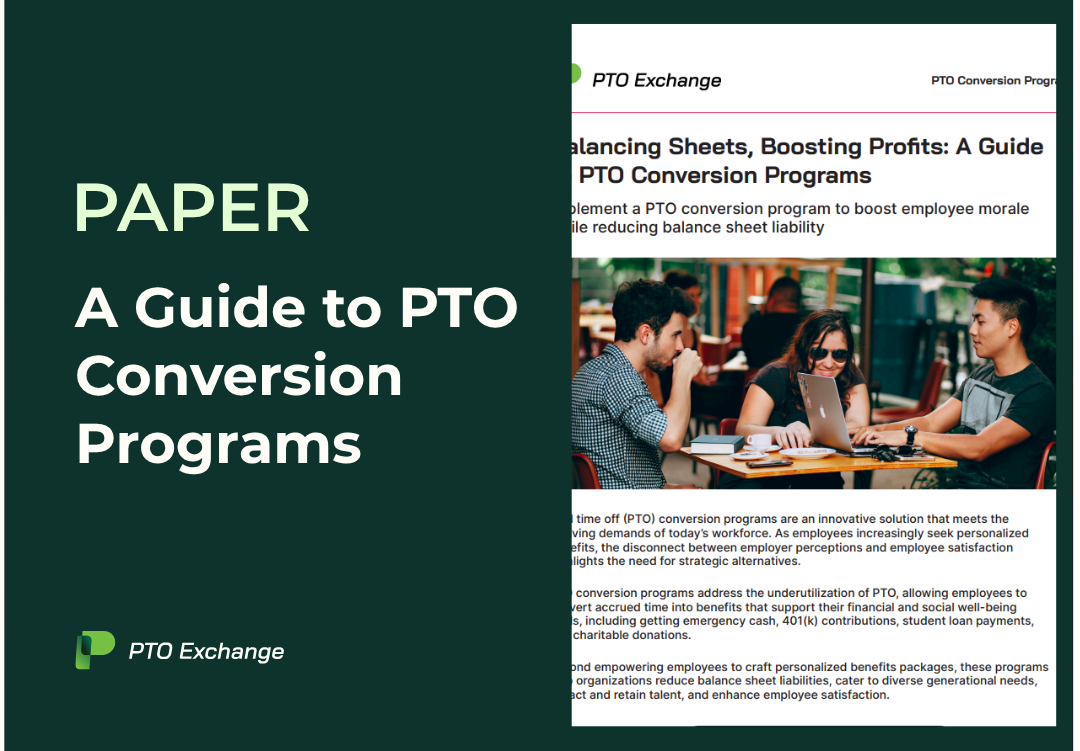
In this e-book, we will dive into how a PTO conversion program can actually allow organizations to reduce their overall PTO liability at a fraction of the cost.
The Challenges of PTO Liability
For many organizations, unused Paid Time Off can become a significant liability on the balance sheet. This liability not only increases over time, especially when employees receive salary raises and promotions, but also compounds with the accumulation of unused time off year after year.
According to the Visier study, the total value of unused PTO in the United States alone is estimated to be over $65 billion annually. This amount represents compensation that employees have earned but have not utilized, often due to an unwillingness or inability to take time off.
For companies, these unused PTO hours represent a deferred expense, which is a growing liability that sits on the books but is not being utilized effectively. As this liability grows, it can strain company finances, especially when organizations face
pressure to reduce operational costs or improve financial efficiency.
Despite this, many companies struggle with how to creatively manage their PTO policies to reduce these liabilities without negatively affecting employee morale or engagement. The problem becomes even more complex when employees feel they’ve earned the right to take time off as compensation and might resist efforts that limit or alter how they can use their PTO.

The Challenges with Current PTO Management
Traditional approaches to managing PTO are straightforward but limited in scope. Organizations usually implement accrual policies, where employees earn PTO over time, and encourage staff to use it before it expires or they accumulate too many hours.
However, these approaches often don’t solve the root problem of PTO liabilities building up year over year. Some companies may impose accrual caps to control how much PTO an employee can accumulate, but these limits can lead to dissatisfaction if employees feel like they are being unfairly restricted. This can result in frustrated employees who feel they are not being treated equitably, leading to disengagement or even potential turnover.
Other methods, such as "use-it-or-lose-it" policies, can be even more problematic. While they can help prevent the buildup of PTO balances, they often come across as punitive to employees who cannot take time off due to workload, job responsibilities, or other factors. This can contribute to a negative workplace culture where employees feel pressured to work through their time off instead of truly benefiting from it. Such policies, if not carefully managed, can lead to burnout, a decline in morale, and an overall decrease in employee satisfaction and engagement.
Creative Solutions to Lower PTO Liability
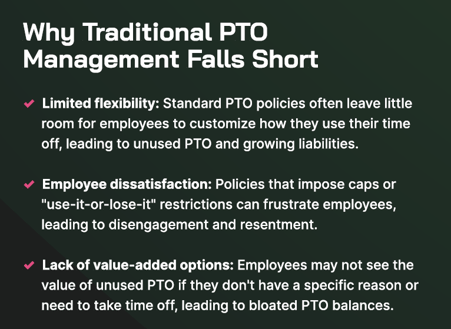 In a typical PTO system, the liability associated with unused PTO can only be addressed by encouraging employees to take time off. However, the problem with this approach is that not all employees are willing or able to use their PTO, often due to pressing work obligations, long-term projects, or personal preferences. Additionally, many employees simply don’t see the value of taking time off if they don’t have specific plans for it, leading to unused PTO accumulating on company balance sheets.
There are very few creative solutions that allow employers to manage PTO liabilities without frustrating employees. Fortunately, PTO Exchange is a game-changing solution that bridges the gap between reducing liability and increasing employee satisfaction. By allowing employees to convert their unused PTO into other valuable financial benefits, such as retirement contributions, emergency savings, student loan payments, or charitable donations, PTO Exchange provides both employees and employers with a win-win solution.
This solution works because it offers employees a new way to use PTO that aligns with their personal financial goals, rather than forcing them to take time off simply because it’s accumulating. Employees can still choose to take their time off as vacation or personal leave, but for those who are, looking to optimize their PTO for financial or philanthropic benefits, PTO Exchange offers them the flexibility they need.
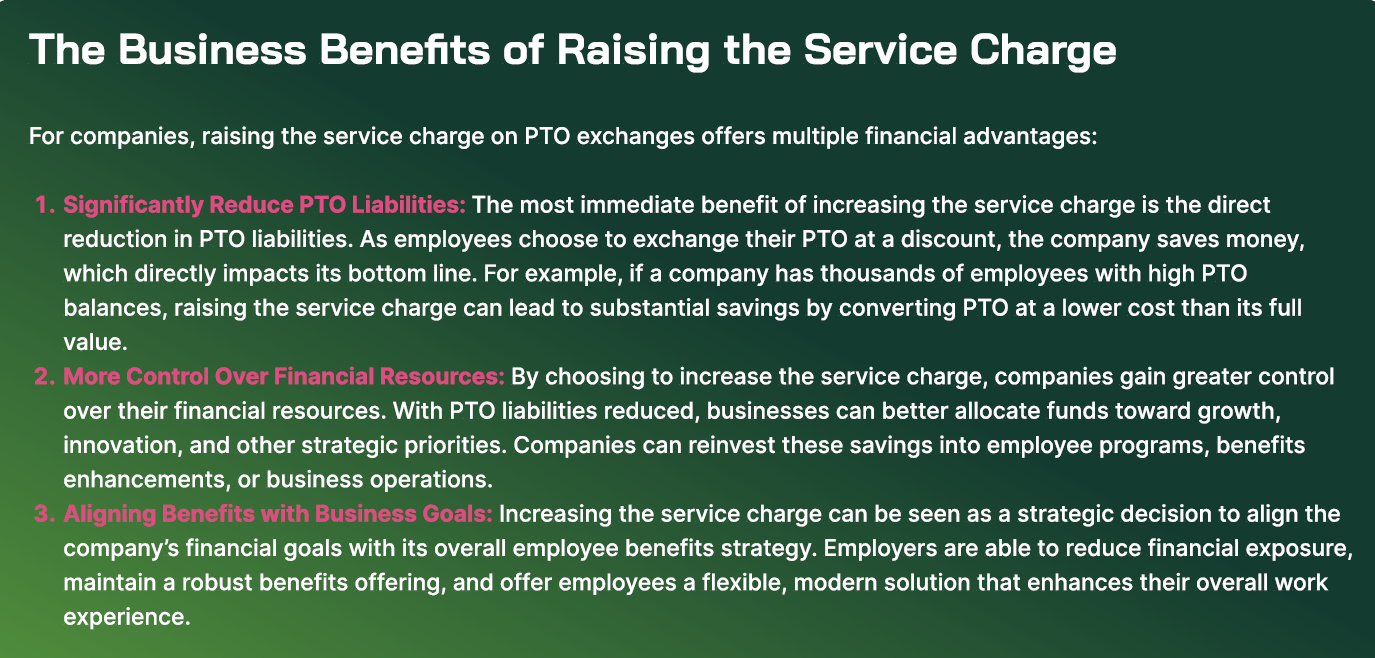
Moreover, PTO Exchange allows employers to set a service charge that can help further reduce PTO liabilities. By adjusting the service charge, companies can convert PTO at a discount, ultimately paying out accrued PTO at a lower dollar amount while maintaining the program’s flexibility. This ability to monetize unused PTO without negatively affecting employees’ choices gives employers an innovative tool for balancing financial efficiency and employee satisfaction.
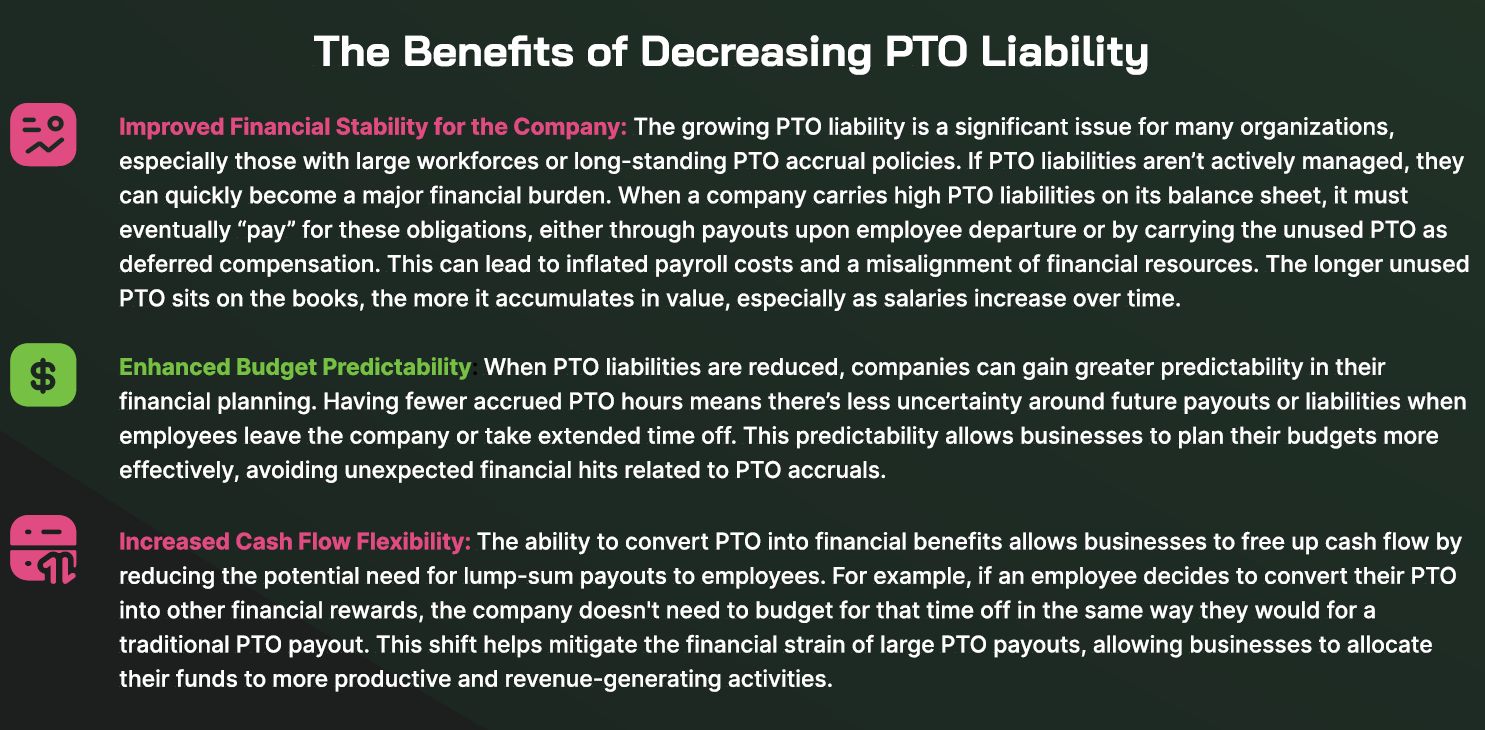
The financial burden of PTO liabilities is a significant challenge for many companies, particularly those with large workforces and high PTO accrual rates. By allowing employees to exchange unused PTO for financial benefits, companies can lower their PTO liabilities, gain better budget predictability, and improve employee engagement and retention. Additionally, the flexible service charge model allows organizations to take further control over their PTO liabilities while still offering employees valuable benefits.
The Impact of Increasing the Service Charge
As we've explored, PTO Exchange offers companies a unique opportunity to reduce PTO liabilities while enhancing employee satisfaction through the flexibility to convert unused PTO into meaningful financial benefits. However, one of the most powerful features of PTO Exchange is the ability for employers to adjust the service charge percentage, which can have a significant impact on both the company’s finances and the overall employee experience.
Due to IRS regulations, PTO conversion programs require the employee to to incur a small service charge on the value of the time they are exchanging. By increasing the service charge beyond the required 7.5%, companies can effectively convert PTO at a discount. This not only helps reduce PTO liabilities even further but also creates additional financial flexibility for the organization. Let’s dive deeper into how this practice works and why it can be a strategic advantage for companies.
How the Service Charge Works and Its Impact
PTO Exchange automates the 7.5% service charge on all transactions, as required by IRS guidelines. This fee is used to ensure is not invoked and ensures compliance with tax regulations, specifically as it relates to the deferred nature of PTO. However, companies have the option to increase this fee—essentially charging a higher service charge to employees who wish to exchange their PTO for other purposes.
When an organization increases the service charge above 7.5%, employees are still able to exchange their PTO, but at a reduced rate. For example, if an employee has $1,000 worth of PTO available to exchange and the service charge is set to 15%, the company is effectively paying $925 for that PTO, instead of the full $1,000.
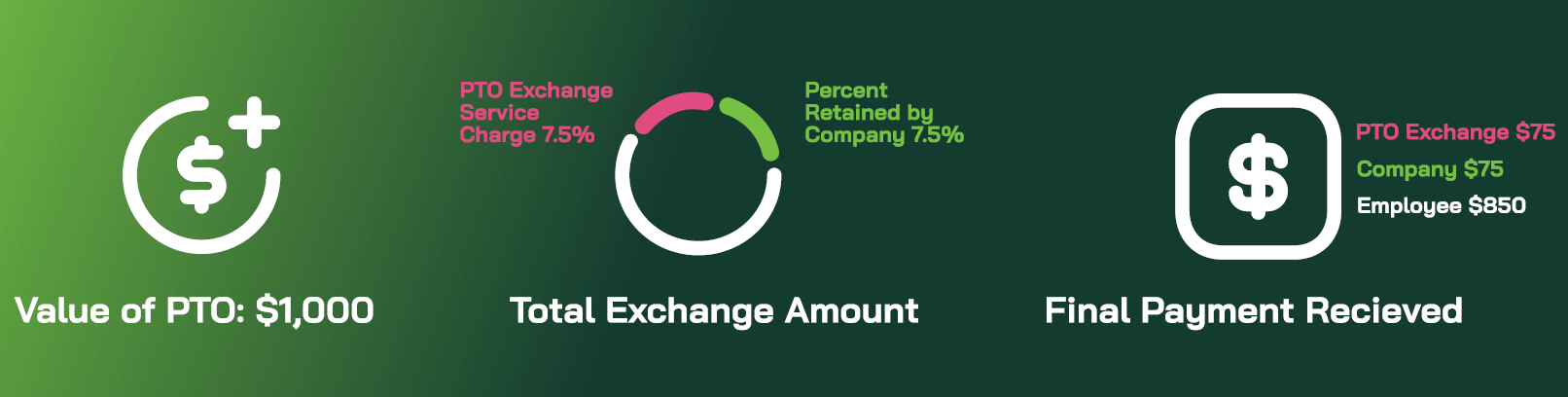
While this might seem small for one transaction, in a large organization and across many exchanges, this savings can lead to thousands of dollars saved on PTO accrual expenses every year. This allows the company to reduce the financial impact of PTO exchanges while still providing employees with the flexibility to use their PTO for retirement savings, emergency funds, or other financial goals.
Why Do Employees Agree to a Higher Service Charge?
You might wonder, "Would employees be willing to pay a higher service charge just to exchange their PTO?" The answer is yes- and here's why:
-
Employee Financial Goals: Employees increasingly prioritizing financial wellness and flexibility in their benefits package. The ability to convert PTO into savings for retirement, emergency funds, student loans, or even charitable donations is extremely valuable. Many employees are more than willing to accept a higher service charge if the benefits they receive in return align with their financial needs and goals.
-
Choice and Flexibility: Importantly, employees are not forced to pay the higher service charge. They can choose to continue using their PTO in the traditional way, taking time off as they would under a standard PTO policy. For those employees who see the value in converting PTO into meaningful benefits, the higher service charge is a small price to pay for financial flexibility. There is no fee to add PTO Exchange to your Total Rewards plan; our solution operates like a voluntary benefit.
- Transparency and Education: Clear communication about how and why the higher service charge works is key to employee acceptance. When employers explain that the service charge allows them to provide employees with greater financial flexibility, employees are often more receptive to the change. Transparency in how the program works and how it benefits them can build trust and increase participation.
Case Studies of Companies Using PTO Exchange
Let's take a closer look at three companies that have successfully leveraged the ability to increase the service charge on PTO Exchange to achieve a better return on investment.
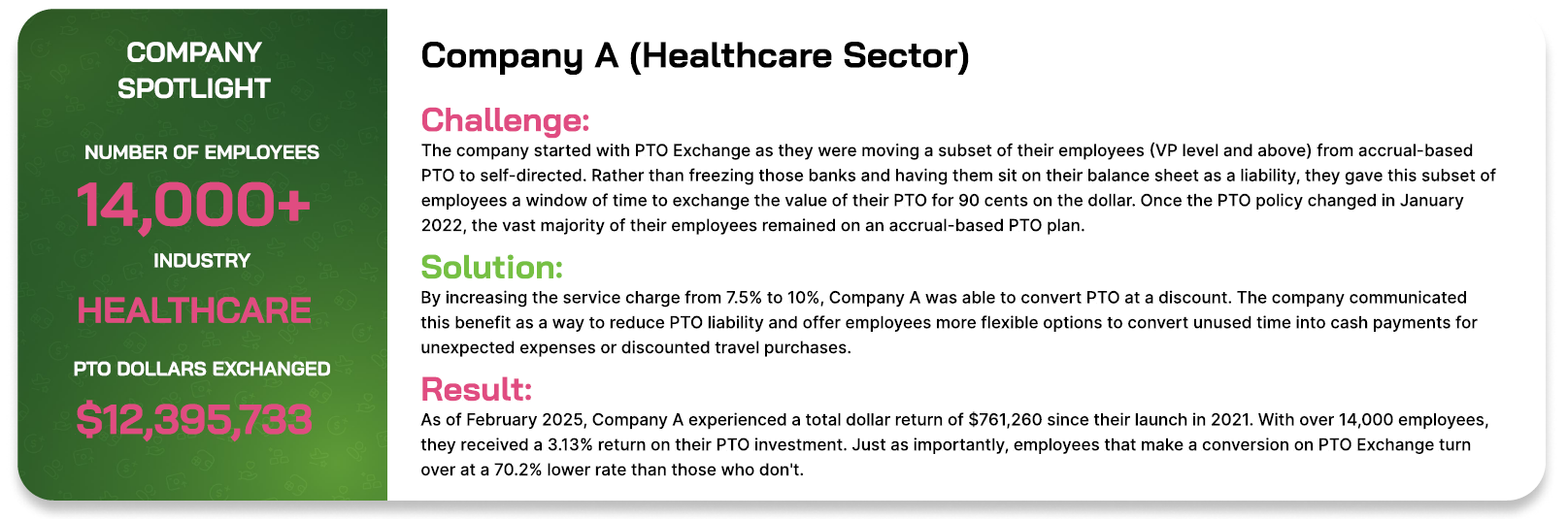
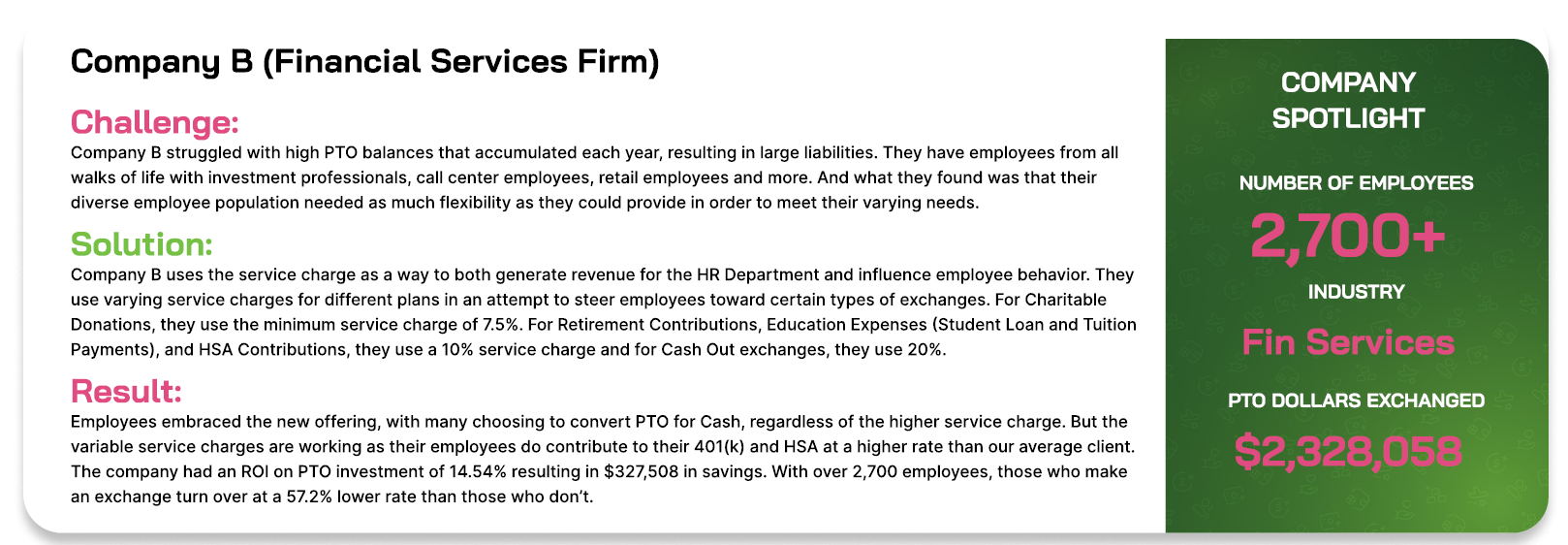
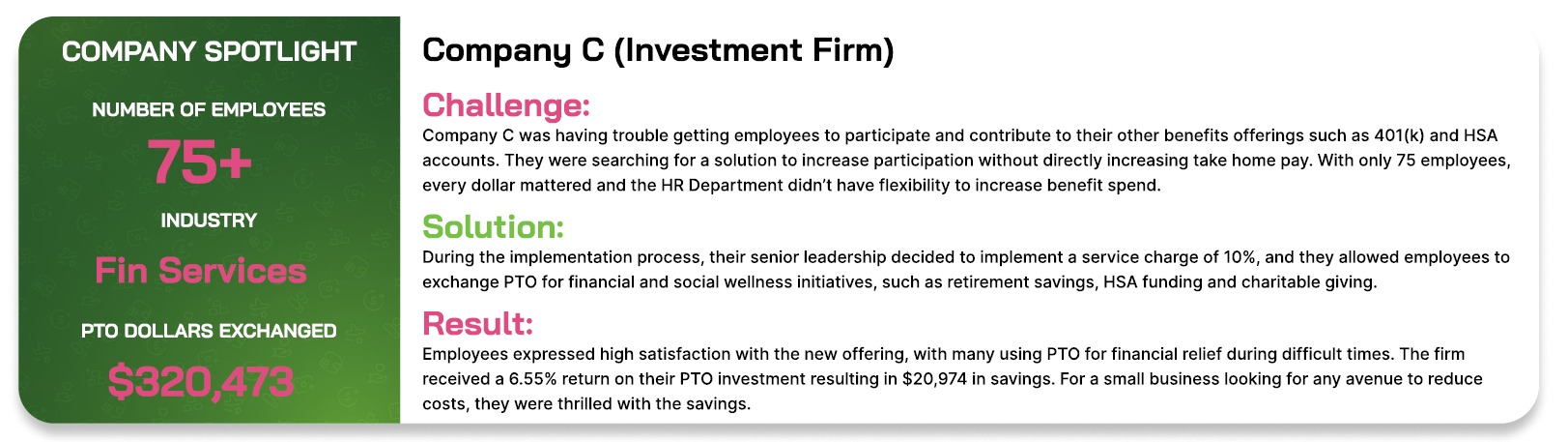
Maximizing ROI with PTO Exchange
One of the key reasons PTO Exchange is so effective is its flexibility. Employees have the freedom to choose how they want to use their PTO, and they don't need to opt into the exchange program if it doesn't align with their personal needs. This means that employees who are satisfied with taking their PTO as time off can continue doing so, while those who prefer financial flexibility can take advantage of the program.
For employers, this flexibility means that PTO Exchange can be tailored to meet the needs of diverse workforces, including employees at different stages of their financial journey. It’s a win-win solution that benefits both employers and employees.
Reducing PTO liability is more than just a financial strategy—it's a key lever for improving an organization's overall financial health and workforce satisfaction. As PTO balances grow, they not only add to the company’s liabilities but also lead to potential burnout and disengagement if employees are unable or unwilling to take time off. By effectively managing PTO, employers can not only reduce financial strain but also create a more productive and engaged workforce.
The option to increase the service charge on PTO Exchanges compounds the benefits of PTO Exchange exponentially. This approach allows companies to convert PTO at a significantly discounted rate, which reduces the overall PTO liability while still providing employees with a meaningful and flexible benefit. Employees benefit by having the ability to use their PTO in ways that are important to them—whether that’s for retirement savings, emergency funds, or even charitable donations. With the service charge in place, employers can strike a balance between controlling costs and offering employees a valuable option that enhances their financial wellness.
PTO Exchange is the solution that helps companies achieve this balance. By providing the ability to exchange PTO for personal financial goals, businesses not only reduce their PTO liabilities but also foster a culture of flexibility and financial well-being. PTO Exchange offers a highly customized product to fit your business needs and challenges. Plan selections, service charge, and policy requirements can all be personally built to make the platform work for you.
If you’re ready to reduce PTO liability, boost employee engagement, and provide your team with a flexible benefits offering, PTO Exchange is the solution.
Schedule a demo today and learn how PTO Exchange can transform your PTO strategy, improve your financial health, and enhance employee satisfaction. Let us help you unlock the full potential of your PTO program and achieve long-term success.

“This is about as easy as it gets! I was able to exchange my PTO faster than my newborn spits up formula - which is FAST! Also, I was holding my newborn when I did it, which shows exactly how fast and easy it is.”

“I benefitted from donated PTO many years ago, which was so helpful for my family and me. I was blessed that my coworkers wanted to assist when my family members were significantly injured in an auto accident.”
Ready to Modernize Your PTO Program?
Unused vacation doesn’t have to go to waste. With PTO Exchange, you can turn unused PTO into a strategic benefit—helping employees support their families, reduce debt, save for retirement, or simply gain peace of mind.
👉 Schedule a personalized demo
👉 Explore use cases and client stories




![image 34 [Vectorized]-1](https://ptoexchange-6854878.hs-sites.com/hubfs/PTO2026/image%2034%20%5BVectorized%5D-1.svg)
![image 35 [Vectorized]](https://ptoexchange-6854878.hs-sites.com/hubfs/PTO2026/image%2035%20%5BVectorized%5D.svg)
![image 36 [Vectorized]](https://ptoexchange-6854878.hs-sites.com/hubfs/PTO2026/image%2036%20%5BVectorized%5D.svg)
![image 37 [Vectorized]](https://ptoexchange-6854878.hs-sites.com/hubfs/PTO2026/image%2037%20%5BVectorized%5D.svg)