

3,000,000+ PTO Hours Exchanged
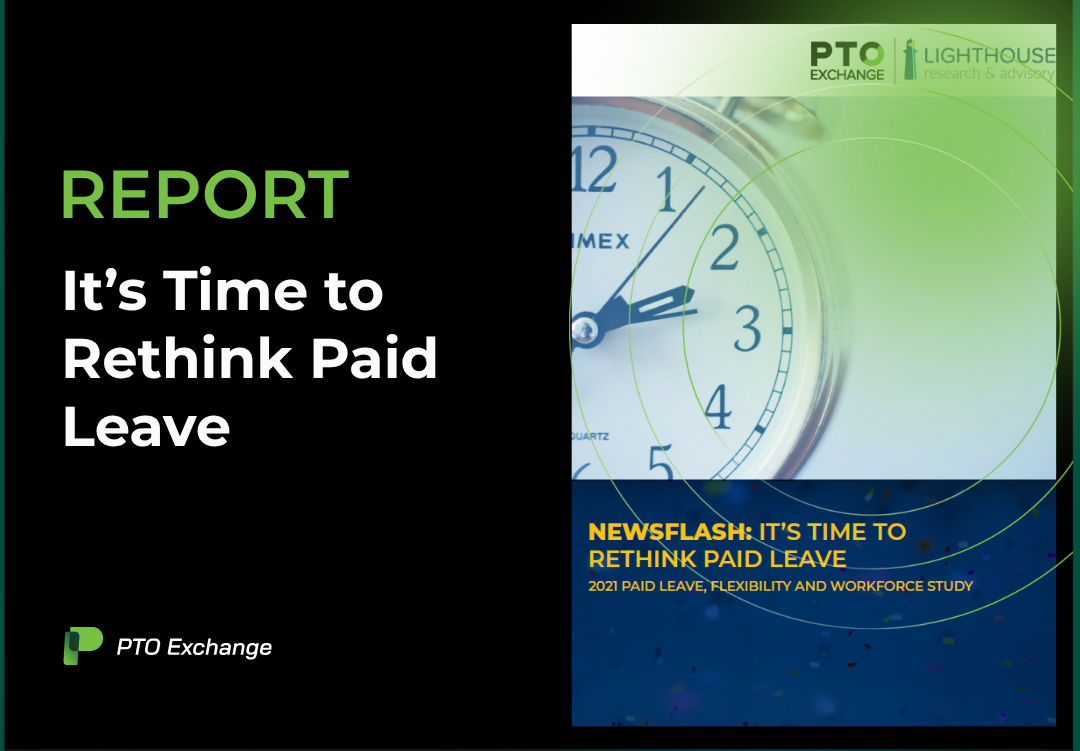

This custom research was conducted in November and December, 2021. It is based on survey responses from 1,000 employees working full-time at firms that offer an accrued paid time off (PTO) vacation policy. Respondents were US-based and worked at organizations with less than 50 to over 10,000 employees, spanning a wide variety of industries and professions. Demographics include representation by gender, age, and ethnicity and represent the view of the entire working population statistically with a 99% confidence level +/- 4% margin of error. Full details on the survey sample size can be found at the end of this report.
Download Full Report HERE PTO Exchange - Time to Rethink PTO Research Report
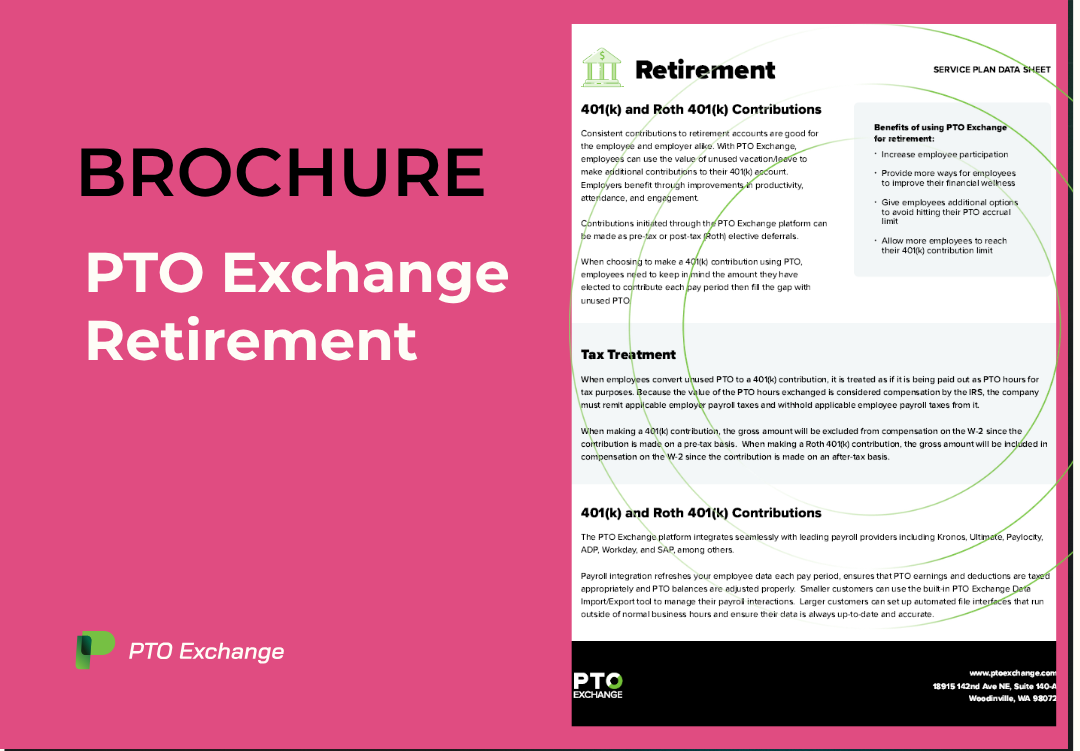
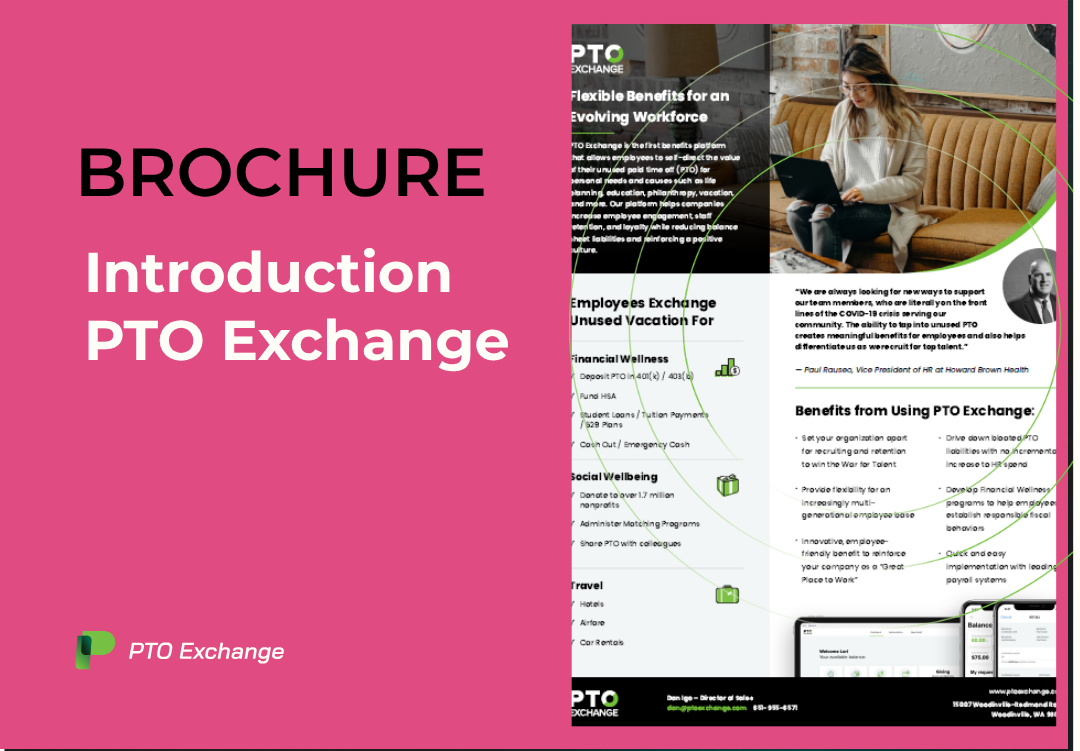
PTOExchange is the first benefits platform that allows employees to self-direct the value of their unused paid time off (PTO) for other needs and causes, including retirement, student loan repayment, cash, discounted travel, charitable donations and more.
Statement of Ethics: as an independent analyst firm, our research and reporting provide unbiased, neutral views of the HR trends and technologies impacting work today. While this specific research was vendor-funded, it does not impact how we share the data with employers and practitioners. If you have any questions, please contact us.

One of the most consistent employee benefits offered by employers is paid time off (PTO), and it’s often left on autopilot. However, as the data below indicate, it’s time for employers to take a new look at paid leave, because it can be stressful and difficult for employees to get the full value of the benefit. To make things worse, employers are also carrying increasingly large
balances of paid leave, increasing organizational risk. It’s time to rethink paid time off.


CONCLUSION
The foundational truth of this research is that every employee is unique, and offering them all the same benefit may not serve their needs in the same manner. Flexibility when it comes to managing, leveraging, and/or converting PTO is a way to address the needs of an increasingly diverse workforce, driving powerful employee retention and engagement.
In the last few years, work has changed dramatically for many. From where they work to how they work, the dynamic change has brought about new challenges, sure, but also new opportunities for their employers to connect, engage, and support them. This has led to changes in a wide variety of standard offerings, from training and compensation to career mobility and
benefits.
One of the most common benefits offered today is paid leave. Employers set up accrued leave plans so that workers can save up time to use for personal needs, both planned and unplanned. However, it is time to rethink paid leave, based on inputs from the workforce.
This report is going to explore new findings from the Lighthouse Research & Advisory 2021 Paid Leave, Flexibility, and the Workforce Study, which was sponsored by PTO Exchange and gathered inputs from 1,000 North American workers to understand their preferences, priorities, and concerns when it comes to paid leave. For clarity, we only gathered responses from those individuals with jobs that offered benefits including paid leave.
The demographics covered men, women, a wide variety of industries, and a broad range of ages and professions. Full details of the survey sample size can be found at the end of this report. As Figure 1 below indicates, it’s time to rethink how we offer leave, how we allow employees to use it, and what value it can unlock for employers and the workforce in the modern work environment.

According to the research, more than half of the workforce craves additional flexibility in how they
can use their accrued time off. Within the scope of this report, we will also examine some options
for how leave can be converted into other benefits that employees desire based on their own personal
priorities.
It’s important to note that paid time off (PTO) is not static. When someone earns an hour of paid leave,
it’s set aside at their current pay rate. However, if they don’t take it for a year and a half and end up
getting a 20% pay raise in that time, the leave is paid out at the 20% higher rate. Therefore, getting
employees to take the leave or use it in other ways is not only beneficial to the company, but it’s also
valuable and helpful for the employee as well.
To put it another way, high PTO balances are an organizational risk not just because of a large
amount of dollars sitting on the balance sheet waiting to be cashed in, but also because of the
increased risk of stress and ultimately departure if employees don’t get some relief.
While paid leave programs are designed to ensure people take time away from work, the data shows us over and over that most employees do not take all of their vacation each year, for a variety of reasons.
Therefore, being able to use the accrued time off in other flexible ways can lead to reduced stress as well.
Within the context of this report, we’ll explore the following key concepts as they relate to this topic:
The current state of employee paid time off: how people use leave, why they don’t, and why that matters.
Rethinking paid time off in today’s dynamic workplace: what it takes to support a modern worker with flexible benefits.
The impact of flexible benefit choices: how benefit options and choice can impact recruiting, worker retention, and employee engagement.
The goal here isn’t just to talk about another trend or guess at future talent priorities. We’re going to use real data that represent the North American workforce to indicate just how big of a priority this should be within your own organization and how to solve for it.
According to the study, only four in 10 employees use their leave every year. The other 60% have trouble taking it all within the calendar year when it’s earned, due to a number of factors.
First of all, the pandemic shifted how much leave people take and how they take it, as Figure 2 below indicates.

Due in large part to the pandemic and its travel limitations, approximately 80% of workers took less time than they did in a normal year. Further, those taking fewer than 10 days off jumped by 55% compared to a non-pandemic year.

But that’s not all. Other key finding revealed in the study:
Income gaps: 56% of workers making less than $49,000 a year use all their vacation time, but 72% of those making over $125,000 do. Lower income workers are less likely to be able to take advantage of this benefit to its full extent, citing too much work followed by concerns about job security and manager perceptions.
Gender gaps: in the study we found that women were 43% less likely than men to say that they use all their leave every year, citing hesitancy around how they would be perceived at work, job worries, or lack of ability to afford a vacation.
Racial gaps: Nonwhite employees are 19% less likely to take all their leave every year compared to white workers, with the ability to afford a vacation showing slightly higher for this group.
Any one of these factors would be a cause for concern, but taken as a whole, it paints a picture of a system that is too inflexible to support the evolving needs of an increasingly diverse workforce
To take a different approach, let’s visit the aggregated amount of vacation that has been earned but not yet exercised, as shown in Figure 3.

While about one in three workers have less than 10 unused days, the other two thirds have anywhere from two to five-plus weeks of leave that they haven’t utilized. Again, this isn’t just a cost to the employers in terms of a liability on the books–it’s a cost to the workforce when they do not use or get access to that earned time and compensation.
It’s time to rethink how we approach paid leave, and the workers themselves have some ideas about how we can do it in a meaningful way.
Have you ever had that moment when you realized that your vacation balance was about to hit the maximum accrual amount, meaning you would lose any time you continued to accumulate? It’s a strange feeling knowing that you absolutely must take time off just to avoid losing it. If you have, you’re in good company: three in four workers have taken an unneeded or unnecessary vacation in order to avoid losing their accrued vacation time.
The phrase “use it or lose it” applies to paid leave in multiple respects. In the example above, workers can only accumulate so much before they max out their leave balance. However, other companies have policies that dictate workers must use their paid leave in the calendar year or forfeit any balance. While those policies are not inherently “bad,” they are built around the idea that we must:
Manage or remove business liability to employees when it comes to paid leave; and
Try to encourage employees to use a benefit in a constrained, company defined timeframe.
Remember, this is supposed to be a benefit we’re offering for their sake. Speaking of benefits we offer for the sake of our employees, it’s worth calling out unlimited PTO or uncapped leave programs briefly. Some companies see these as the solution to remove ongoing liability from the books and give some measure of flexibility back to the workforce

But workers are the ones who end up losing in these scenarios. Different studies show downsides of unlimited PTO options ranging from employees working more often when on leave to employees taking less time off overall34.
But what if there were other options, like being able to convert paid leave into other resources that are more flexible and personalized? Would the workforce be interested in that? You better believe it.

3. https://www.insider.com/people-with-unlimited-pto-policies-spend-every-vacation-working-2019-6
4. https://workforce.com/news/unlimited-paid-time-off-is-a-deceptive-ploy-in-todays-workplace

To aggregate the numbers featured above, 83% of the workers in North America are very or extremely interested in using their paid leave to support their various personal financial needs. Only 3% report no interest at all.
But how? What would they do with that time if they had some options beyond “use it or lose it?” For starters, 80% of workers say that they would donate time to a coworker in the event of an emergency. This is more than just a safety net–it demonstrates a willingness to commit to each other and a culture of care that most business leaders can only dream of.
This kind of thing happens every day, and people quietly serve and support each other without expecting any payback. In a personal experience years ago when I served as an HR Director, one of our employees started with us on a Monday.
On Tuesday, a tornado ripped through town, destroying his home completely. On Wednesday, seven of his coworkers anonymously donated enough leave for him to take two weeks off to spend time with his family grieving the loss of their
home and working with his insurance company and a builder to begin the process of rebuilding.

Further, there are some interesting demographic breakdowns that show just how important this could be for different workers:
Low income: 40% of workers making under $49,000 a year would like cash for emergencies.
High income: those earning more than $125,000 a year would be most interested in health savings account contributions.
Gender: women were 33% more likely to want emergency funds for unexpected expenses than men.
Older workers: 30% of those workers age 54+ want to use it for retirement contributions, which is four times more likely than someone ages 18 to 24.
Younger workers: One in five workers ages 18 to 24 want to use the funds for student loan repayments.
Clearly there is demand for this flexibility, and the varying choices allow workers of all different walks of life to exercise the benefit in a way that matters most to them in their personal situation. In a workforce that is becoming increasingly multigenerational, HR leaders know it is difficult to find benefits that are meaningful to the entire spectrum of their employee population.
The good news is that the ability to convert PTO into other uses is not only possible, but increasingly easy to implement, thanks to companies like PTO Exchange, this report’s sponsor. Taking a more flexible approach and rethinking paid leave and its purpose could change how employers support the workforce forever, but is it just another thing to offer? Is it just one more benefit? Or does it really leave a demonstrable, visible impact in terms of retention, engagement, and satisfaction?
Next, we’ll share our findings from the study that definitively answer those questions.
Earlier in this report, we made the case that the current system and benefits are too rigid to meet the needs of the diverse set of workers employed today. To put it another way, one of our studies a few years back found that when we build a solution for the average person, we ignore any employees who aren’t “average.” The rigid, historical way that leave benefits have historically been offered and managed is exactly that. It serves an average use case, but workers who don’t fit that mold are left with something they can’t fully leverage or receive the full value.
However, flexibility and choice can solve this problem by putting more power into the hands of workers themselves. The study clearly shows the intense interest from the workforce in having a more flexible, personalized option to convert paid leave into other financial resources. But the impact and value goes so far beyond simply using leave for other purposes, as Figure 6 indicates


In a world where engagement scores and trust are at all time lows, this is an incredible statistic. Seven out of 10 employees say that having a flexible leave benefit would make them feel like their company values and appreciates them.
But the most powerful statistic in the study went even further, asking workers about their intent to stay with their company. With unprecedented levels of voluntary turnover and resignations in the employment landscape in the last two years, anything that supports employee retention is a major component
in business and talent strategy today.
Nine out of 10 North American workers say that having access to these benefits would make them more likely to stay in their job.
For some of you, that might be enough. But as a research organization, it’s our job to understand the “why” behind these decisions and concepts whenever we can. The final question in our study looked at flexibility and how employees define it. Many employers think flexibility is just about where someone works, but the workforce doesn’t see it that way.


What’s incredible is that, unprompted, workers put “choices about where I work” at the bottom of the list. At the top? Choices about how work gets done. Autonomy. Empowerment. Options. That’s what matters to people more than anything else.
And yes, other options exist here around pay, benefits, and more, but the overwhelming theme is the power of choice.
In the modern workplace, workers demand and crave choices. Personalization is a key part of how we interact with systems, organizations, and people in our personal lives, but when we get to work that often falls to the wayside. Employers often say they want to embrace flexibility, but they aren’t sure where to start. This report has outlined a clear, effective starting point for increasing flexibility within the workplace, and it has also highlighted the clear value as well in terms of employee retention and engagement.
Many healthcare organizations and hospitals offer valuable paid time off benefits, but in times of short staff, high demand, and unprecedented health concerns, it can be incredibly difficult to find time to take off from work.
For one regional health system with six acute care hospitals, outpatient surgery centers, a cancer care network, and other healthcare operations, this set of circumstances led to more than $40 million in accrued PTO on the balance sheet. In order to manage the risk associated with this, the organization planned to place a cap on PTO but worried about the impact it would have on those staff with a high balance.

To not only address that potential challenge but also support the needs of a diverse workforce with more than 10,000 staff, the healthcare organization implemented PTO Exchange in late 2021.
The response was incredible: more than $3.5 million in PTO was converted by employees to other resources in the first five weeks after going live. Beyond reducing the financial liability, other benefits included:
Standing out as an employer of choice for skilled talent during a tight labor market.
Flexible options for employees to leverage earned leave based on their personal priorities.
Paying out leave at pre-merit increase pay rates, reducing overall ,company spend.
With more than 71,000 hours exchanged by the firm’s workforce, it became immediately clear that it was serving a real need, enabling staff members to feel appreciated and supported in a way that other companies often struggle to match.

In an era where companies struggle to create strong ties with their community, STRATACACHE used something as seemingly simple as paid leave to demonstrate a culture of care and community.
STRATACACHE is a technology firm supporting retail experiences and customer journeys for global organizations. The business has supported more than three million software activations for clients, demonstrating leadership in its area of focus.
The company’s goal was to raise money for a young girl with a rare disease, enabling the family to purchase a much-needed wheelchair-accessible van in order to facilitate medical treatment visits.
STRATACACHE leaders began the campaign by offering to match employee funds dollar-for-dollar. Staff across the company immediately jumped in, offering a portion of their paid leave balance in support of this important cause. In less than 48 hours, the company was able to raise the $45,000 to cover the purchase of the vehicle.
Beyond the initial focus, employees have continued to use their PTO Exchange benefits for financial wellness, additional donations, and more.

With more than 71,000 hours exchanged by the firm’s workforce, it became immediately clear that it was serving a real need, enabling staff members to feel appreciated and supported in a way that other companies often struggle to match.
These findings come from a survey of 1,000 full time workers with benefits located in North America. Data were collected in November 2021 via a blind survey and represent the view of the entire working population statistically with a 99% confidence level +/- 4% margin of error.

Statement of Ethics: as an independent analyst firm, our research and reporting provide unbiased, neutral views of the HR trends and technologies impacting work today. While this specific research was vendor-funded, it does not impact how we share the data with employers and practitioners. If you have any questions, please contact us.
PTOExchange is the first benefits platform that allows employees to self-direct the value of their unused paid time off (PTO) for other needs and causes, including retirement, student loan repayment, cash, discounted travel, charitable donations and more. PTO Exchange helps companies engage employees and retain staff in a tight job market, strengthen culture and community, and reduce balance sheet liabilities. PTO Exchange also supports flexible benefits through Life Planning Accounts. PTO Exchange is SOC 2-certified and trusted by STRATACACHE, UCare, 4 Wall Entertainment, Generac, Howard Brown Health and others. Learn more at www.ptoexchange.com
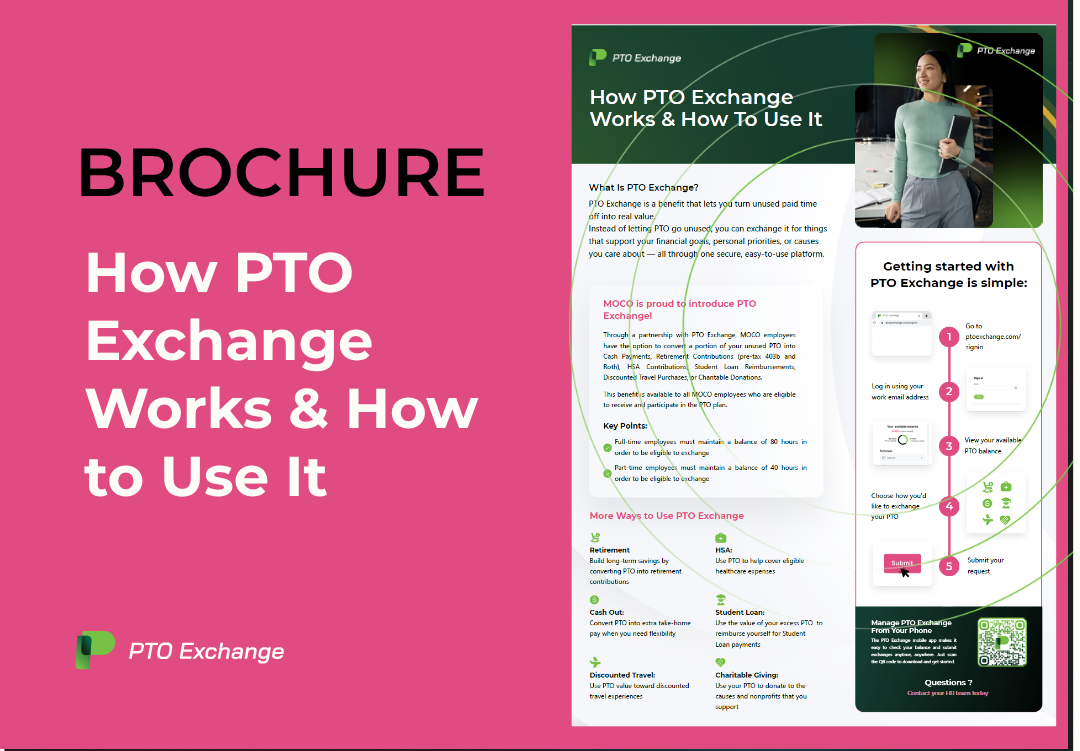
Unused vacation doesn’t have to go to waste. With PTO Exchange, you can turn unused PTO into a strategic benefit—helping employees support their families, reduce debt, save for retirement, or simply gain peace of mind.
👉 Schedule a personalized demo
👉 Explore use cases and client stories
 Link copied!


Your email address will not be published. Required fields are marked *

![image 34 [Vectorized]-1](https://ptoexchange-6854878.hs-sites.com/hubfs/PTO2026/image%2034%20%5BVectorized%5D-1.svg)
![image 35 [Vectorized]](https://ptoexchange-6854878.hs-sites.com/hubfs/PTO2026/image%2035%20%5BVectorized%5D.svg)
![image 36 [Vectorized]](https://ptoexchange-6854878.hs-sites.com/hubfs/PTO2026/image%2036%20%5BVectorized%5D.svg)
![image 37 [Vectorized]](https://ptoexchange-6854878.hs-sites.com/hubfs/PTO2026/image%2037%20%5BVectorized%5D.svg)

Leave a Reply