
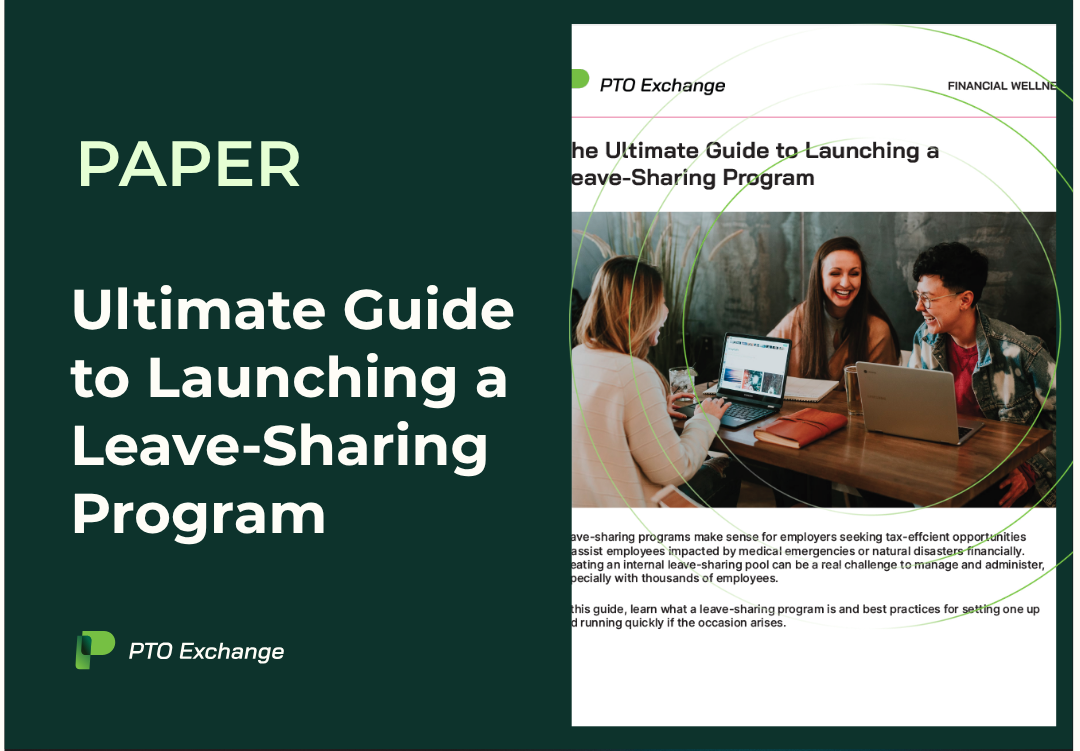
Ultimate Guide to Launching a Leave Sharing Program

Leave-sharing programs make sense for employers seeking tax-effcient opportunities to assist employees impacted by medical emergencies or natural disasters financially. Creating an internal leave-sharing pool can be a real challenge to manage and administer, especially with thousands of employees.
In this guide, learn what a leave-sharing program is and best practices for setting one up and running quickly if the occasion arises.
What is a Leave-Sharing Program?
Unlike other forms of PTO, leave-sharing programs are specifically for employees impacted by emergencies. The IRS approves the following two criteria for leave-sharing programs:
1. Medical emergency: Individual/ family member of the individual requiring an extended leave of absence
2. Federal disaster or national emergency: The President declares a disaster and can exist for 18 months from the date of designation
There are no rules for who can participate in leave-sharing programs, but there are some tax implications for the donor:

Emergency Medical Leave:
In a medical emergency, predicting how many days you will need to give yourself or your family member the proper care can be difficult. With this said, emergency medical leave can be available permanently. Through leave sharing, employees can get this extra time; however, employers must meet several criteria that the IRS must consider:
-
The request must be in writing and administered to the employer
-
Specifies leave is only for medical emergencies (illness or death of individual/family member)
Federal Disaster or National Emergency:
Unlike medical emergencies, the President must declare federal disasters or national emergencies under the Stafford Act, which can exist for up to eighteen months. After this nationwide recognition, employees facing adverse consequences from an emergency may utilize a leave-sharing program in case they need extra days off. Similar to medical emergencies, federal disaster or national emergencies must follow these requirements to be considered for leave sharing:
-
The request must be in writing
-
Based in the severity of the event
- Only for employees directly affected by the disaster
An employer-sponsored leave-sharing program allows an employee to donate accrued hours of paid vacation or personal leave to benefit other employees who need to take more leave than they have available.

What is a Leave-Sharing Program?
The plan allows employees to voluntarily deposit accrued leave in an employer-sponsored bank for use by other employees affected by emergency medical leave or a federal disaster or national emergency. An employee is adversely affected if it has caused severe hardship to the employee or a family member of the employee that requires the employee to be absent from work.
Any eligible employee can donate unused vacation or PTO but must donate to an established “sharing pool” or leave the bank, not to a specific colleague. Companies can also make one-time or ongoing monetary donations to leave-sharing pools for employees.
This ensures that the time goes to employees adversely affected by the situation. Donating to a pool means no tax implication for the donating employee. However, if an employee were to donate outside of a pool, they must be treated as having W-2 compensation for the donated time based on their pay rate at the time of donation.
An employee who donates leave to such a program will not recognize income as to the deposited leave. Still, the donating employee cannot claim an expense, charitable contribution, or loss deduction for the donation.
Any leave donation received by an employee on leave under this plan will be treated as wages for FICA, FUTA, and income tax withholding. Employees may receive paid leave, at their regular compensation rate, from leave deposited in the leave bank.
The requesting employee of the donated time must make a written request for the time off. Then, the employer is required to make a reasonable determination (based on need) as to the amount of leave an approved recipient may receive from the leave bank.
If accepted, employees must use this leave for purposes related to a major disaster. A leave recipient may not convert leave from the leave bank into cash instead of leave but may use such leave to eliminate a negative leave balance incurred due to an advance of leave resulting from the disaster. The leave recipient may also substitute leave received under the plan for unpaid leave used because of the disaster.
The amount of leave that an employee may deposit in any year generally is, at most, the maximum amount of leave that the employee accrues typically each year. Any leave remaining in the bank at the end of the major disaster must be returned to the donors in the same proportion as the amounts of leave they donated bear to the total amount of leave donated.

Benefits of a Leave-Sharing Program
There are several benefits to setting up a leave-sharing program:
-
Boost employee engagement and morale. When employees feel they are taken care of, they feel more engaged at work, resulting in higher morale and productivity.
-
Show care and empathy. By offering a leave-sharing program, employers show that they care about the well-being of their workforce outside of the office.
-
Reduce balance sheet liability by giving employees a unique way to use their accrued PTO. By donating PTO to a leave-sharing pool, employees can use their PTO before they lose it, and companies don’t have to carry the expense of it on the balance sheet.
-
Offer a flexible benefit to attract and retain employees. When given a choice, employees are more likely to choose employers offering more flexible benefits that address individual needs. A leave-sharing program can be a competitive differentiator regarding employee benefits.
Five Considerations For Setting Up a Leave-Sharing Program
Which type of leave-sharing program?The plan allows employees to voluntarily deposit accrued leave in an employer-sponsored bank for use by other employees adversely affected by a personal hardship or natural disaster, resulting in the employee being absent from work.
What is the budget?
Employers will want to establish a budget for the program and consider limiting the amount of time that can be donated, if any. Remember that the donated time may negatively impact the recipient’s ability to obtain state disability benefits, the enhanced unemployment benefits established under state and federal laws, and/or company-sponsored short-term or long-term disability benefits.
Who are the recipients?
Employers will want to establish the criteria for determining which employees are eligible to receive the donated time. Employers should develop fair and neutral eligibility and selection criteria for selecting donors and recipients.
If the program favors one group or excludes employees in protected categories, the employer may leave itself open to discrimination charges and employee relations problems. In the case of a significant disaster program, the employer may need to establish criteria to determine which employees need the benefits more than others.
What is the donation procedure?
Employers will want to establish the criteria for determining which employees are eligible Employers need to establish detailed procedures for the donors and recipients. In the eyes of the IRS, to establish a valid policy, employers must adopt a written donation policy and establish a process for donors to use when designating how much time they wish to donate. In this regard, employers may consider the following factors when drafting a policy: length of service of the donors and recipients, salaries of the recipients and donors, exempt or non-exempt status of the donors and recipients, etc.
Documenting the voluntary nature of a donation by the donor is highly recommended. Likewise, the recipient should verify that they are using the time for the intended purpose. The employers should document both with a consent form.
Employers should be aware of privacy issues under the Americans with Disabilities Act, the Health Insurance Portability and Accountability Act, and the California Confidentiality of Medical Information Act. Under these laws, employers are prohibited from announcing to the workforce why an employee needs the donated time.
Who will administer the program?
Lastly, employers will want to designate an employee or group to administer the leave-sharing program. Namely, the employer must decide who will be the point of contact for donors and recipients. While the human resources department may seem natural, it may not have the staffing and systems to administer the program. Similarly, the payroll department may have the systems but lack the employee relations expertise to administer the program.
For these and other reasons, external third parties can also provide plan administration and adjudication, which follow written established criteria. Often, this is the most practical solution that reinforces objectivity and transparency to the entire process.
Launch a Leave-Sharing Program in a Day
The PTO Exchange’s flexible benefits platform form facilitates the giving and sharing of PTO for employees who need it the most. If the need arises at your organization, you can turn on this capability within 24 hours. Once turned on, your company can customize qualifications or circumstances for employee eligibility. It is a simple four-step process:
1. Request: An employee fills out a request form, which employers can customize for specific circumstances.
2. Review: An adjudication process accepts or declines the request based on defined criteria. PTO Exchange or internal HR can act as adjudicator.
3. Notification: The employer notifies the requesting employee if their request has been approved or declined.
4. Dispense and decrement. If approved, hours are automatically added to the employee’s leave balance and reflected on the pay stub. PTO Exchange integrates with your payroll system and simplifies the allocation of time based on the hourly earning rate of each employee.
About PTO Exchange
PTO Exchange is the first benefits platform that allows employees to self-direct the value of their unused paid time off (PTO) for personal needs and causes. Employees can self-direct the value of their unused PTO toward options that are meaningful to them personally, such as life planning (retirement funds), education (student loans), philanthropy (offering days to a co-worker or non-profits), and more.
PTO Exchange helps companies increase employee engagement, staff retention, and loyalty while reducing balance sheet liabilities and reinforcing a positive culture. PTO Exchange is SOC 2-certified and trusted by STRATACACHE, Howard Brown Health, UCare, Centre College, Griffin Capital, 4 Wall Entertainment, and others. Request a demo at www.ptoexchange.com.
Ready to Modernize Your PTO Program?
Unused vacation doesn’t have to go to waste. With PTO Exchange, you can turn unused PTO into a strategic benefit—helping employees support their families, reduce debt, save for retirement, or simply gain peace of mind.
👉 Schedule a personalized demo
👉 Explore use cases and client stories



![image 34 [Vectorized]-1](https://ptoexchange-6854878.hs-sites.com/hubfs/PTO2026/image%2034%20%5BVectorized%5D-1.svg)
![image 35 [Vectorized]](https://ptoexchange-6854878.hs-sites.com/hubfs/PTO2026/image%2035%20%5BVectorized%5D.svg)
![image 36 [Vectorized]](https://ptoexchange-6854878.hs-sites.com/hubfs/PTO2026/image%2036%20%5BVectorized%5D.svg)
![image 37 [Vectorized]](https://ptoexchange-6854878.hs-sites.com/hubfs/PTO2026/image%2037%20%5BVectorized%5D.svg)