
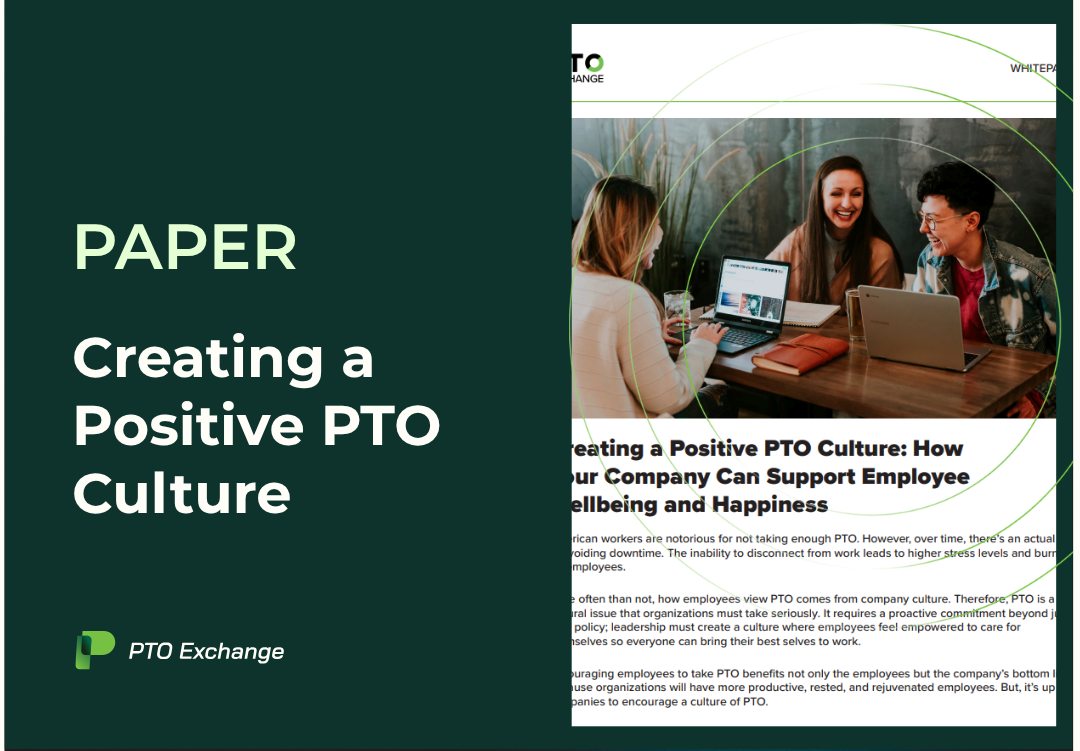
A Healthy PTO Policy Starts With Company Culture
American workers are notorious for not taking enough PTO. However, over time, there’s an actual cost to avoiding downtime. The inability to disconnect from work leads to higher stress levels and burnout for employees. More often than not, how employees view PTO comes from company culture.
Therefore, PTO is a cultural issue that organizations must take seriously. It requires a proactive commitment beyond just a PTO policy; leadership must create a culture where employees feel empowered to care for themselves so everyone can bring their best selves to work.
Encouraging employees to take PTO benefits not only the employees but the company’s bottom line because organizations will have more productive, rested, and rejuvenated employees. But, it’s up to companies to encourage a culture of PTO.

A Culture of Workplace Junkies
We're becoming a society of “work junkies,” workers who cannot take a break. According to a study by My Perfect Resume, 82% of American workers work while on vacation, and 70% admit to answering calls from clients or colleagues. Moreover, 87% checked work emails and messages, while 78% answered phone calls from their boss. Additionally, 42% of workers take vacation days intending to do work uninterrupted.
We all know that vacations (or just time away in general) are necessary, even good for us in the long term. But, we increasingly make excuses to skip, abuse, or distort them. So, why is it so hard for employees to disconnect?
A few reasons:
-
They feel like they need to be “on top of things.” Thirty-seven percent of employees admit to working on vacation so they don’t get behind when they get back.
-
Avoid stigma or negative impressions from colleagues or management for fully disconnecting. Employees fear being perceived as a slacker, getting passed over for job promotions, or having someone angle for their job if they take PTO.
-
The inability to shift to a much slower, relaxed mode after dealing with the fast-paced environment of the office.
- They have too much on their plate or no one to hand work off to. It can be hard to step away if employees are on a small team or the only ones doing their job without any support.

Let's Talk About Burnout
Burnout is the elephant in every HR leader’s room. Burnout is a psychological syndrome involving emotional exhaustion, cynicism, and a diminished sense of personal accomplishment. It’s also caused by (over)working long days each week without taking time off.
Burned-out team members are less productive and creative in their roles—not to mention more stressed. Additionally, a culture of burnout can wreak havoc on workplace retention. When employees feel burnt out, they are less engaged and loyal than their less stressed or burnt-out counterparts. According to a Deloitte study, 42% of workers have left a job because of burnout.
Burnout severely impacts our mental health. However, 57% of employees don’t consider their mental health concerns a valid reason to take time off. They are worried about their bosses judging them for taking mental health days or feeling unable to perform their job if they request time off for mental health care.
Don't Sleep on Downtime
PTO is essential for our mental and physical health. Taking time off work provides a host of psychological and physical health benefits. It’s been linked to reducing depression, better sleep habits, and reduced heart disease and mortality.
Our bodies and brains appreciate the pause, and considering one’s well-being and productivity will pay dividends in the long run. Detaching from work makes people more energetic and resilient. It also boosts productivity and the company’s bottom line. Hence, workers must invest in their physical and mental health, long-term capacity, and productivity.
Using PTO isn’t just for taking a vacation but simply for rest. Whether on a beach halfway across the world or from the comfort of a couch, the key is doing whatever is needed to feel recharged. There are seven types of rest employees can engage in:

- Physical - Physical rest can be passive or active. Passive rest includes sleeping or napping, while active rest is doing restorative activities like yoga or stretching to improve the body's circulation and flexibility.
- Mental - Mental rest is a reminder to slow down. Taking short breaks throughout the day or keeping a notepad at arm's reach are a few techniques to implement to give the mind a break.
- Emotional - Emotional rest gives time and space to express feelings and cut back on people pleasing freely. It requires courage for people to be authentic.
- Social - Our social interactions either fuel or drain us. To socially rest, spend more time with supportive and positive people and less time with those relationships that tend to drain us.
- Sensory - Whether we're on the computer all day, surrounded by constant conversation, or bright lights, our senses are constantly overwhelmed. Include moments of sensory deprivation throughout the day to reset and prevent sensory overload.
- Creative - Anyone will benefit from creative rest if they constantly solve problems or brainstorm new ideas. Spending time outdoors or surrounding oneself with awe and inspiration can awaken the wonder inside us.
- Spiritual - Spiritual rest is connecting beyond physical and mental and feeling a deep sense of belonging, love, acceptance, and purpose. To feel spiritual rest, engage in something greater than oneself and add activities like gratitude, meditation, or prayer to the daily routine.
More companies are trying to eliminate fears of taking time off by encouraging PTO and self-care. And it starts with the company culture.

Start with Culture
Company culture is vital to employee happiness and engagement and can be the difference between employee turnover and retention. Disengaged employees are 3.8 times more likely than their engaged counterparts to cite organizational culture as a reason for leaving. Leaders can boost company culture and decrease burnout by modeling and promoting work-life balance. And the easiest way to do that is by taking time off. Simply put, the more vacation employees take, the more engaged with the company they’ll be.
Company culture plays a vital role in employees’ comfort level when taking time off. Messages leadership sends employees through policies and programs, and how they are implemented and managed speaks volumes about the company’s values. A thoughtful, well-designed, and inclusive PTO program shows employees that managers and executives care about and appreciate them, which can, in turn, positively shift an organization’s culture.
Show Employees You Care
When employers show care, 87% of employees are engaged, 90% are productive, and 89% are loyal. On the other hand, when employees don’t feel like their employers care, the figures drastically drop—engagement (45%), productivity (58%), and loyalty (54%).Care refers to employers demonstrating an interest in their employees’ overall well-being, including financial, mental, physical, and social health.
It also means creating a culture where companies reward employees for their effort. When organizations don’t, this negatively impacts company culture, whereas employee recognition can positively impact company culture. Companies can show their employees they care through a firm PTO policy and an emphasis on work-life balance.
Reinforcement and Encouragement Comes From the Top
Employees believe leaders and managers are responsible for culture. And they are right; culture starts at the top with leaders clearly defining it, communicating it, and setting a good example. Then, everyone at the company needs to be on board with the culture; company-wide adoption is necessary to see the desired cultural change. When organizations have company-wide adoption, employees feel more empowered to practice, develop, and evolve cultural norms. PTO is no exception.
If a company sets a culture of PTO and taking time off, leaders must set an example for the rest of the employees. By not taking time off, leaders reinforce negative assumptions around PTO, making it harder for employees to want to disconnect from work. Positive reinforcement from inside and outside company walls can counteract the guilt many feel for taking PTO.
Managers should encourage employees to take advantage of PTO to return to work refreshed and ready to work and innovate. In addition, they must reinforce the message that vacations contribute to the company’s success.

Create a Healthy PTO Policy That Reflects Your Company Culture
Inclusive PTO Programs
Inclusive PTO programs boost employers’ diversity, equity, and inclusion (DE&I) efforts and positively impact employee engagement, productivity, culture, and overall company performance. To build a culture where employees are encouraged to bring their whole selves to work, knowing which holidays are meaningful to employees is essential.
In addition to federal holidays, many businesses have included additional holidays in their employee benefits to appeal to their workforce’s diverse religious, cultural, and personal beliefs. This initiative shows support and respect for all employees, regardless of religious or cultural background. Several companies have implemented “floating holidays” that employees can take at their discretion in addition to other PTO options, such as volunteer days, mental health and wellness breaks, sabbaticals, and paid relief, giving employees more time to spend with family, friends, and the community.
Leave-Sharing, Donations, and Volunteering
Employees can also use their unused PTO to donate to a coworker in need or donate to charitable causes that are important to them. With leave sharing, employees can donate their unused PTO to a fellow employee who needs extra time off. First, employees can add their extra PTO days to a share pool or a leave bank. Then, their colleagues can request additional time off from the share pool. Once approved, the additional hours are automatically added to the employee’s leave balance and reflected on the pay stub, eliminating the need to take unpaid leave.
Instead of losing their PTO at the end of the year, employees can put it towards charitable causes. Employees can donate the value of their unused PTO to over 1.7 million non-profits. Companies can also match these donations and offer employees volunteer time on behalf of community organizations.
Flexible Benefits
In a multi-generational workforce, employees are of different ages, in various stages of life, and have different physical and cognitive abilities. Flexible benefits are another solution to cater to the needs of a diverse workforce. With flexible benefits, organizations can allow employees to turn their unused PTO into causes that benefit them, such as travel, philanthropy, and financial wellness. Employees can create customized benefits packages that meet their individual needs. Additional flexible benefits programs, like a life planning account (LPA), can help employers show employees that they care about their work-life balance and overall well-being.
Incentivize Taking Time Off
One of the simplest ways to reward employees and encourage them to take time off is to implement incentivized vacation use. Incentivized vacation use results in reduced employee burnout and higher levels of employee engagement. Many companies pay their employees through vacation bonuses, stipends, or expense reimbursements if they take their vacation time.

Another way to incentivize employees to take PTO is to implement mandatory PTO. Whether it’s a company-wide shutdown or a set number of days employees must take over a given amount of time, mandatory PTO encourages employees to disconnect from work to rest and recharge.
In addition, employees feel more encouraged to take mandatory PTO because they know it’s something even their managers and company leaders have to abide by, so they won’t feel like they’ll miss out on staying logged into work. Compensating employees for leaving the office sends a strong message that PTO should be used and celebrated rather than something employees should be ashamed to ask their managers for approval. Incentivizing PTO is a short-term investment in the employee that can result in a long-term impact on the company.
More than just the financial impact on the company and the wellness impact on the employee, incentivized PTO also helps organizations create a positive culture around PTO.
Make Taking PTO a Better Experience for Employees
Part of creating a better company culture around PTO is to make taking PTO a better experience for employees. Here are some actions that HR leaders and managers can take to make it easier for their employees to take PTO:
-
Prepare for employee departure. Ensure the person taking over the employee’s workload while they’re out has all the relevant documents and is up to speed on all the employee’s current projects.
-
Help your employees wind down their workload and tie up loose ends. The last thing employees want is to feel like they are up against the clock before they head out on PTO, so help them get their workload to a place where they can go on PTO without worrying about the status of their work projects
-
Audit the company’s PTO policy. Determine where the company’s PTO policy aligns and where it doesn’t, to support employees’ well-being. What can change to make it more effective for your employees?
-
Encourage PTO from the top. Employees will be more encouraged to take PTO if their managers and other company leaders take time off.
-
Schedule more time for breaks during the workweek. If an organization doesn’t have as much allocated PTO, more scheduled breaks during the workweek can help employees feel less overwhelmed and more mindful so they don’t feel as burnt out.

A Healthy Culture Around PTO Is Important
It's not just enough to have a PTO policy; a company culture that supports and positively reinforces the policy is also needed. For example, employers can improve employee engagement, retention, and productivity by instilling a work-life balance and well-being culture, along with inclusive PTO programs. But change has to come from the top—managers have to set the example and communicate that taking a vacation doesn’t just benefit the employee but the company’s success as a whole.
PTO Exchange is a flexible benefits platform that allows multi-generational workforces to unlock the power of their unused PTO and turn it into causes that matter the most to them. Gone are the days of a one-size-fits-all benefits program. Instead, employees can create customized benefits packages with PTO Exchange to meet their individual needs.
Learn more about how PTO Exchange’s flexible benefits platform allows employers to create an inclusive benefits program to support a healthy PTO culture. Schedule a demo today to learn more about PTO Exchange’s Benefits Exchange Platform and how we’re helping organizations nationwide support their employees.
Ready to Modernize Your PTO Program?
Unused vacation doesn’t have to go to waste. With PTO Exchange, you can turn unused PTO into a strategic benefit—helping employees support their families, reduce debt, save for retirement, or simply gain peace of mind.
👉 Schedule a personalized demo
👉 Explore use cases and client stories


![image 34 [Vectorized]-1](https://ptoexchange-6854878.hs-sites.com/hubfs/PTO2026/image%2034%20%5BVectorized%5D-1.svg)
![image 35 [Vectorized]](https://ptoexchange-6854878.hs-sites.com/hubfs/PTO2026/image%2035%20%5BVectorized%5D.svg)
![image 36 [Vectorized]](https://ptoexchange-6854878.hs-sites.com/hubfs/PTO2026/image%2036%20%5BVectorized%5D.svg)
![image 37 [Vectorized]](https://ptoexchange-6854878.hs-sites.com/hubfs/PTO2026/image%2037%20%5BVectorized%5D.svg)